Greatest moments in athletics history: 1960-69

We look at some of the finest performances from the 1960s in our 'greatest moments' series to mark the 80th anniversary of AW
Rudolph’s Roman treble
Aged just 20, in 1960 Wilma Rudolph became the first American woman to win three gold medals in a single Olympics when she strode to victory in the 100m, 200m and 4x100m relay in Rome.
She had become an Olympian as a 16-year-old in Melbourne, anchoring the relay team to gold, but it was in the Italian capital four years later that her star shone brightest.
She was the first woman to break 23 seconds, with her run of 22.9 at the AAU Championships and continued to stand out when it came to the Games themselves.
In the 100m, her winning margin was 0.25 as she clocked 11.0, well inside the world record but with an illegal 2.8m/s tailwind. For the 200m, Rudolph broke the Olympic record with 23.2 in the heats and was a commanding winner in the final following her run of 24.0. The hat-trick was completed by the 4x100m, in which the US team set a world record of 44.4 in the heats.
Back to back for Bikila
“Watching Bikila Abebe [sic] during the race was an almost mystical experience,” wrote Mel Watman. “How can a man reel off 26 miles in 5:02 apiece and seemingly remain as fresh and composed as when he started out? The rest of the world’s distance runners would dearly like to know.”
The former AW editor penned those words in the pages of this magazine to describe the heroics of the Ethiopian who was in the process of successfully defending his Olympic marathon title in Tokyo.

Bikila had announced himself four years earlier, when he became Ethiopia’s first Olympic gold medallist thanks to winning the marathon, barefoot, in a then world record of 2:29:27.
Given that he had undergone an appendectomy 40 days previously, he was not expected to repeat his heroics in Japan. Yet, wearing shoes this time, he finished over four minutes clear in 2:12:11.2 to break the 2:13:55 world record of Britain’s Basil Heatley, who was second.
Rand realises a dream
“I would much rather have a world record than an Olympic medal, really,” Mary Rand told AW’s Mel Watman in the lead-up to the Tokyo Olympics. “To be the best in the world, even if it was only for a day, would be absolutely marvellous. Of course, the greatest thing of all would be to set a world record at the Olympics.”
That is precisely what she did. After setting an Olympic long jump record of 6.52m in the qualifying round, she opened up the final with a UK record of 6.59m before reeling off a brilliant series of 6.56m, 6.57m, another Olympic and UK record of 6.63m, a fifth round world record of 6.76m into a 1.6m/sec wind and 6.61m.

Her performance made her the first British female athlete to claim an Olympic gold medal.
Matthews makes amends
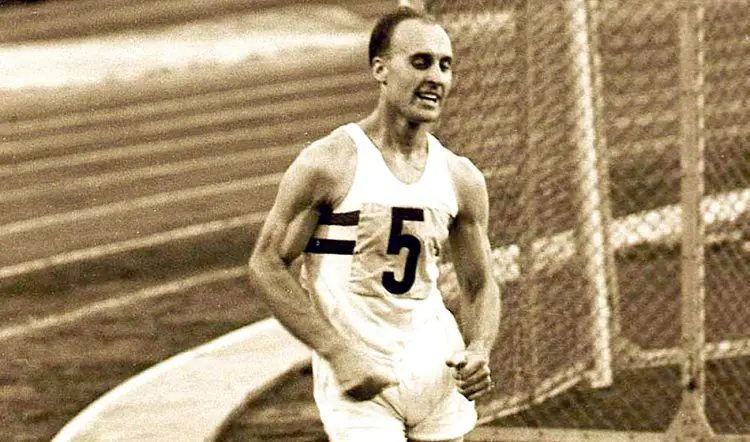
A second gold medal for Britain in Tokyo came courtesy of Ken Matthews in the 20km walk. Four years earlier, in the searing heat of Rome, he had collapsed and was taken to hospital. This time he judged his race to perfection. By halfway he was 24 seconds clear, a lead he had extended to 1:40 by the finish.
That walkers were still unfairly regarded as second class citizens in the world of athletics became apparent when Britain’s other Tokyo gold medallists quickly featured in the Queen’s Honours list but it wasn’t until 13 years later that, following a campaign organised by the Race Walking Association, Matthews at last received his MBE.
Packer blazes a trail
When Ann Packer travelled to the Tokyo Olympics in 1964, she did so as favourite to win the 400m. The 800m, a distance at which she had no international experience, was almost an afterthought.
There was to be huge disappointment for the Briton in her favoured event, when Australia’s Betty Cuthbert took 400m gold just ahead of her, and Packer had to be persuaded by her
fiancé and fellow team-mate Robbie Brightwell to tackle the two-lap task.
In the final, Packer had a slow start and Maryvonne Dupureur was well ahead at halfway. However, the former found a way back into the race and surged off the last bend, passing the Frenchwoman to win in a world record time of 2:01.1, becoming the first British woman to win the 800m Olympic title.

Davies defies expectations
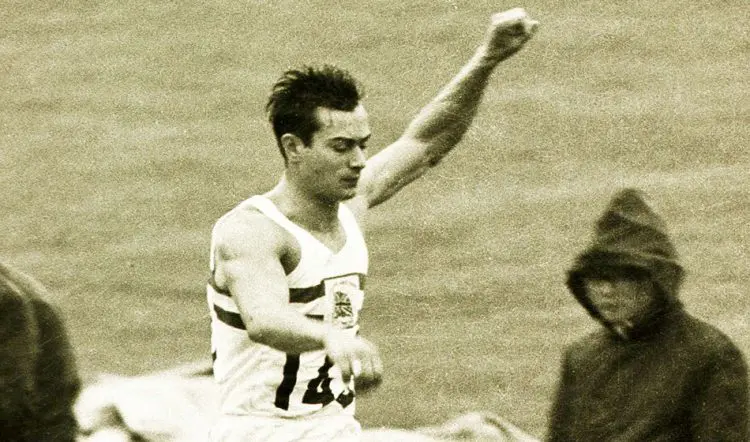
Even though he qualified for the 1964 Olympic long jump final with the second-longest effort, Lynn Davies was not expected to come out on top in Tokyo.
However, the Welshman defied those expectations with a leap of 8.07m that saw him beat US defending champion Ralph Boston by four centimetres.
The rainy, cold conditions played into Davies’ hands but he took his chance and was the only British man to win Olympic long jump gold until Greg Rutherford’s win in 2012.
Peter Snell’s Tokyo double
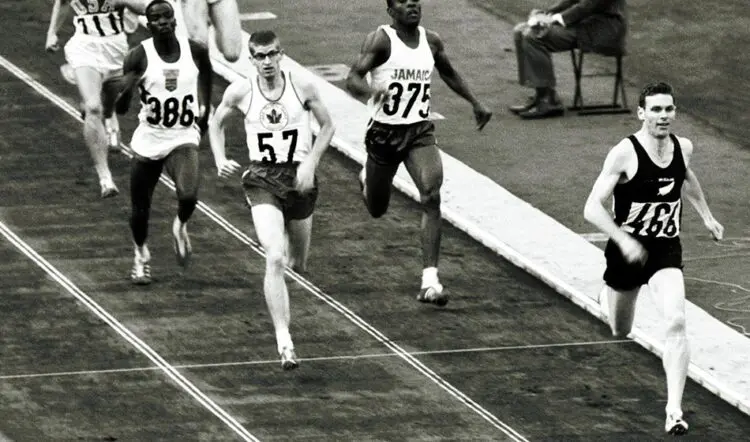
Peter Snell’s international career was short but the highlight of it still reverberates today.
He announced himself to the world with Olympic 800m gold in 1960 and in 1964 he was favourite to become the first man since Britain's Albert Hill in 1920 to win the Olympic 800m/1500m double.
The New Zealander had hardly raced over 800m since breaking the world record in 1962, but, with 300m to go, he unleashed his kick and won convincingly in 1:45.1.
In the 1500m final, Snell found himself boxed in but was helped by Britain’s John Whetton, who sportingly moved aside to let him through. With 200m remaining, Snell was able to change gear once again and completed his double mission in 3:38.1. No male athlete has matched the feat since.
Ron Clarke’s record-breaking 1965
Fuelled by the disappointment of Tokyo, where he won 10,000m and finished ninth in both the 5000m and marathon, Ron Clarke set about making amends in 1965, setting 11 world records across eight distances during that year.
The first came in January, when he took down Vladimir Kuts' 5000m mark with a time of 13:34.8 in Hobart. Clarke returned to action in Auckland on February 1, once again improving his own mark with 13:33.6 and in March he established a world record for the 10-mile distance, finishing in 47:12.8. In Los Angeles in June, he not only posted a blistering 13:25.8 for 5000m but also broke another of his own records, running three miles in 13:00.4.
In Turku, he bettered his own 10,000m record with 28:14.0, though it was never officially ratified due to an issue with race authorisation, his fine form continued as his three-mile mark fell to 12:52.4 in July and his six-mile mark went to 26:47.0 in Oslo as part of his 10,000m world record of 27:39.4.
He capped off his extraordinary year in Geelong, Australia, where he set both the 20,000m world record with 59:22.8 and the one-hour record, covering 20,232 metres in that time.

Beamon’s giant leap
It might have been aided by the altitude of Mexico City but, in 1968, Bob Beamon shocked the world.
Mel Watman was in the stadium to see long jump history being made and wrote for AW at the time: “With one jump Beamon transformed all ideas of what is humanly possible in his event and, by implication, in all others.
“Here was the man to be feared, the one who could wrap up the title with an initial jump of 28 feet (8.53m). Fast on the runway (he's a 9.5 100 yards sprinter) the lanky, loose-limbed American took off amid gasps of astonishment. Never had such elevation been seen in a long jumper.

“What mattered though was where he landed, and as he touched down after what was to prove the longest unaided flight by man, the crowd by the pit exploded with excitement. The officials in charge of measurement seemed to be taking an awfully long time so it seemed a pretty good bet that the world record of 8.35m had been bettered, but was it as far as the magical 28 feet? Still no figure flashed on the electrical indicator board, then suddenly everything was happening.
“Beamon was dancing around, kissing the track even, and fellow competitors dashed over to congratulate him. At last the board flickered into life. The figure 8 flashed up, then a 9 … momentary confusion then the stupefying realisation that the jump was 8.90m. A frantic check of the tables … 29 feet 2 inches!”
It was a mark that stood until 1991.
Fosbury is far from a flop
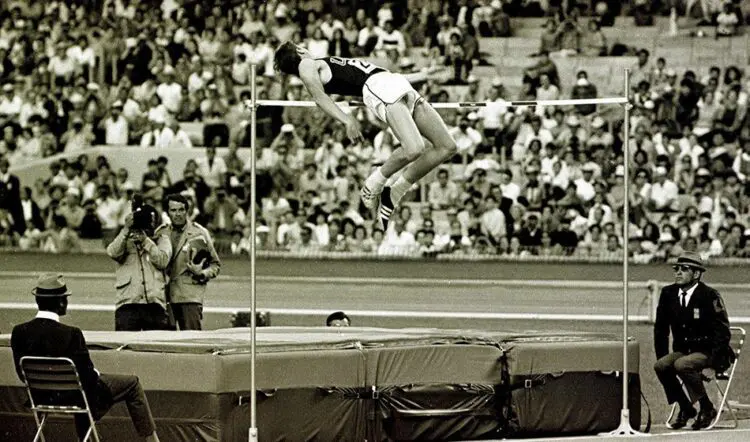
Before Dick Fosbury, high jumpers would use either the Western roll or straddle techniques, with the torso going over the bar sideways or belly-down. That all changed, however, when the American leapt over the bar backwards.
He was always quick to point out that he was not the first to jump backwards given that Debbie Brill, a Canadian who won Commonwealth Games titles in 1970 and 1982, was also using the technique, which was dubbed the “Brill bend”.
But Fosbury said: “I was just blessed to be the first one to discover it and have success with it at this high level. So I got naming rights, something I am very proud of."
The world got their first glimpse of the flop at the 1968 Olympics, which Fosbury won with a Games record of 2.24m before he attempted to break Valeriy Brumel’s five-year-old world record of 2.28m.
Although none of his attempts at 2.29m came close, his impact had been well and truly made and, by the time of the 1972 Olympics, 28 of the 40 jumpers were “flopping”.
Hemery’s hurdles perfection
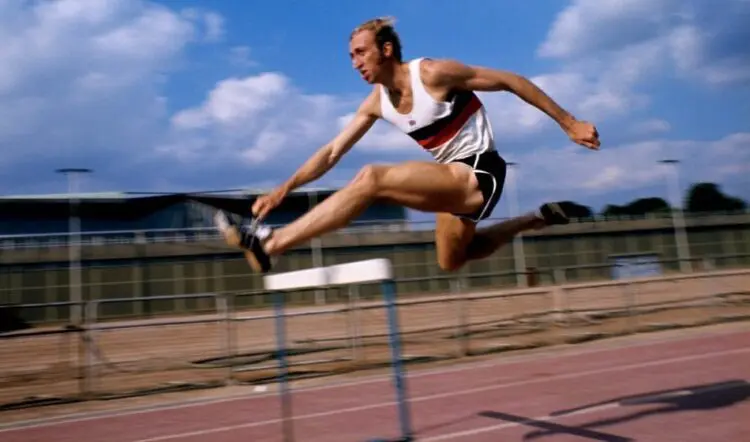
It wasn’t so much the fact that David Hemery won Olympic 400m hurdles gold in 1968, it’s the manner in which he won it that truly stands out.
His British record in the semi-finals hinted that something special might be in the offing, but a display of power, speed and technique that had never been seen before took him to the title in a world record of 48.1. He received his medal from David, Lord Burghley, who had won gold for Great Britain in the same event 40 years earlier.
Hines hot foots it to 100m record
On October 14, 1968, Jim Hines settled into his blocks for the 100m final at the Mexico Games. It was the first Olympics on a synthetic track, 2248m above sea level, and, helped by a gentle tailwind of 0.3m/sec the 22-year-old American stormed to victory in 9.95 – the first-ever ratified automatic world record at the distance.
Four days after his triumph he signed for the Miami Dolphins football team. His 100m mark, however, survived for 15 years.
In addition to winning the Olympic 100m title in Mexico, he combined with Charles Greene, Melvin Pender and Ronnie Ray Smith to take the 4x100m gold too in a world record of 38.2. In the run-up to the Mexico Games he clocked a hand-timed 9.9 for 100m in Sacramento and also a wind-assisted 9.8 at the same meeting in 1968.

Outstanding Oerter
With victory in 1956, 1960, 1964 and 1968, American discus thrower Al Oerter was the first track and field athlete to win four successive Olympic gold medals, breaking the Games record on every occasion.
His sporting career was almost cut short in 1957, when he was involved in a serious car crash, but returned to successfully defend his Olympic title. Oerter set his first world record in 1962 (he set four in total during his career) and was the first to break 200 feet.
His third Olympic title came despite suffering from injuries ahead of the Games. He had a neck problem which meant he had to wear a brace, while just a week before Tokyo he tore cartilage in his ribs and competed in great pain. A third round 64.78m gave him that fourth Olympic title.
Did you know?
The synthetic running track was invented in 1962 by Theodore Buchholtz, George M Rambosek and Richard G Drew. Automatic timing was used officially in athletics for the first time at the 1964 Olympics